

Aries Rewilded: 5 Totem Animals of the Cardinal Fire Sign

Updated: Jul 23

Today is the day of the Spring Equinox in the Northern Hemisphere, and the day that the Sun ingresses into the astrological sign of Aries, the first sign of the zodiac. As the Sun enters Aries, a new astrological year begins. This coincides with the vernal equinox every year, and makes the zero degree point of Aries a particularly important point in the zodiac wheel, symbolic of initiation and a new cycle beginning.
This post is the first of a series I will be writing over the course of this astrological year. Beginning with Aries, we will take a look at each of the zodiac signs in turn, and investigate their attributes through a collection of members from the animal kingdom. Each animal embodies the sign in their own way through their mythology and their natural way of being, and we shall see how connecting with each might allow us a different way of relating to various aspects of a sign’s energy.
First though, a little bit of historical context might be helpful…
A Brief History of the Tropical Zodiac & the Meanings of the Signs
The tropical zodiac is the zodiac used by most Western astrologers. When the tropical zodiac was first established over two thousand years ago, it was intentionally aligned with the seasons and the corresponding agricultural cycles as experienced by cultures in the northern hemisphere. It was constructed around the key turning points of the year: the two solstices (Summer and Winter, marking the longest and shortest days) and the two equinoxes (Spring and Autumn, when day and night are of equal length). This system originated in ancient Mesopotamia with the Babylonians, and was later refined by the Greeks and the Romans. It was Ptolemy, the Greek astronomer, mathematician and philosopher, who is understood to have finalised the tropical zodiac as we know it today in his 2nd century CE work Tetrabiblos.
It is important to note that the decision to maintain use of the tropical zodiac in Western astrological practice was quite deliberate, despite knowledge of the concept of precession, which you may have heard of. Precession - also known as the precession of the equinoxes - is an astronomical phenomenon wherein the signs of the tropical zodiac are drifting away from the constellations by about one degree every seventy-two years, due to the wobble of the Earth on its axis. This was discovered by Hipparchus in the 2nd century BCE (over 300 years before Ptolemy’s time) and is the so-called ‘logic’ behind the misinformed narrative that “your zodiac sign has changed”, which you may have seen rear its head in various guises every so often.
The point to take away here is that the decision to cement the use of the tropical zodiac in Western astrological tradition was made with purpose and deliberate intention (and that therefore no, your Sun sign hasn’t changed!). The consensus was that maintaining the alignment of the signs with the seasons made the most meaningful sense in terms of their symbolism, and in simplest terms, this is why we still use the tropical zodiac in astrology today despite its increasing deviation from the actual astronomical constellations. Astrology is, as it has always been, a language of symbolism and not literalism.
Aries: the Trailblazing Spirit of Spring
Now we’ve established that the meanings of the tropical signs are derived from their seasonal and agricultural correspondences, let’s take a look at what this means for the first sign of the zodiac, Aries.
As I mentioned at the beginning, Aries is closely connected with the Spring Equinox. It is a fire sign, full of drive and passion, and its modality (the way it expresses its energy) is known as cardinal. The Cardinal signs (Aries, Cancer, Libra and Capricorn) sit at the four turning points of the year (the Spring Equinox, Summer Solstice, Autumn Equinox and Winter Solstice respectively) and mark the beginning of the new seasons. They are initiatory in nature, bringing forth new ideas and a momentum for starting new things, although each does this in its own unique way based upon its element and its position in the zodiac wheel.
In Aries, the Cardinal Fire sign, as we might expect this energy comes forth with a bold, optimistic and pioneering spirit which confronts life head first. This is the vital energy of the first flowers bursting from the earth with enthusiasm, vibrant and full of life, ready to take on the world. At its best, Aries gives us the confidence to begin again even in the face of uncertain outcome, and brings the get-up-and-go mentality to take action - to do rather than just thinking… and sometimes without thinking! At its worst though, Aries can be impulsive, impetuous and aggressive, and can lack the focus or staying power to see things through - a flame sparking too suddenly and too brightly before burning out. It is ruled by the planet Mars after all, named for the Roman god of war who incidentally also gives the month of March its name.
Totem Animals of Aries
the Ram

The sign of Aries is traditionally represented by the Ram. Envision an image of a ram in your mind’s eye, leaping into action head first, horns down and ready to confront life - this is Aries. He embodies confidence, conviction and action. If you’ve ever worked with sheep, you’ll know that the ram of the flock is often the one with the unruly reputation, difficult to contain or keep still. He lives in the heat of the moment, and isn’t afraid to compete, butt heads or ‘do battle’ (the phrase ‘to lock horns’ might be of relevance here!).
The ram’s purpose in life is to pass on his genes, and he will willingly engage in astonishingly fierce conflict with another ram in order to achieve this. This is reflected in Aries’ headstrong, passionate and sometimes argumentative reputation, and also its association with desire, fertility and new life.
The shadow of Aries, as alluded to above, can show itself in its obstinate nature, and there is a lesson to be learned here about taking action too quickly, in the heat of the moment and without thought or consideration. The Greek mythological tale of the ram with the golden fleece is extremely relevant here (and is actually how Aries got its name!). In this story, Athamas had been convinced by his children’s stepmother that the sacrifice of his son Phrixos was demanded by the gods in exchange for restoring the fertility of the land. In truth, Zeus neither wanted nor required this sacrifice, and ordered Hermes to send a winged golden ram to retrieve Phrixos. The ram then flew eastwards (the direction of the dawn, also associated with the Spring Equinox - we can see the resonances here) with Phrixos upon his back, and brought him to the court of King Aeëtes on the island of Colchis. In thanks, Phrixos sacrificed the ram to Zeus and gave its golden fleece to the king, who dedicated it to the war god Ares (Mar's Greek counterpart) and hung it in his sacred grove. In honour of the ram’s swift rescue and its sacrifice, Zeus bestowed upon him his eternal place in the heavens as the constellation of Aries.
The Lamb

Although similar to the ram for obvious reasons, I feel the lamb is still worth a mention as another totem animal of Aries, and I have separated them out here because of the very different qualities that each embodies.
Whilst the ram is characteristic of Aries’ assertive and driven nature, Aries is often also equated with the vibrance and vitality of youth, and this is what the lamb represents. Picture the young lambs, now about six weeks old and starting to grow in confidence, bounding tirelessly around the pasture whilst their mothers graze - or better yet, if you live rurally, take a moment when you’re next out and about to stop and watch them. Notice the feelings that they evoke in you as they play. Their carefree joy and abandonment always brings a smile to my face, and this is another side of Aries that we don’t always consider. For the lamb, inexperience can be a blessing. They do not hesitate for fear they may trip and fall, nor do they partake in their mother’s wary watchfulness for predators; they live in the moment, their little hearts brimming with the promise of their new life. Whilst of course there must always be balance for their naivety not to pose a danger to them, those of us who tend to dither or worry before taking action (and who might therefore decide not to act at all!) might benefit from holding the lamb as a totem animal. The lamb teaches us joy in the moment, and that sometimes it’s ok not to take ourselves so seriously.
Both the lamb and the ram, as symbols of new life and fertility respectively, are apt representatives of Aries and the Spring Equinox, and indeed they are so well-placed in this role that we continue to see this in traditions that are still very much alive today. Images of the lamb pop up every year at Easter, which in the Christian calendar always falls on the first Sunday following the first full moon after the Spring Equinox. There is no accident in the symmetry between Christians celebrating the resurrection of God’s son and the much older tradition of honouring the rebirth of the physical Sun, as light triumphs over dark at equinox.
The Wolf

To discover other possible totem animals of Aries, we can look to its ruler, Mars. Two of the animals most sacred to Mars were the wolf and the woodpecker, and to understand why these two very different creatures are both animals of Mars, we should turn first to his mythology.
The short version of this tale is that Mars’ twin sons, Romulus and Remus, were abandoned at birth and set adrift on the river Tiber. Washing up in the shallows by the riverbank, they were picked up by a she-wolf who had lost her own cubs. She cared for the boys, suckling them as if they were her own, and received help in this endeavour from a woodpecker who would also bring them food. Romulus and Remus would later go on to become the founders of Ancient Rome.
Of these two animals the wolf - known as a skilled hunter, fierce protector and (when necessary) savage aggressor - is who we would most naturally associate with the warrior god and the sign of Aries. The deadly precision of the wolf and its ability to get what it wants echo Aries’ powerful will to act. Those with a lot of Aries in their natal charts may therefore be natural born leaders, and we can also see this reflected in the wolf’s position at the top of the food chain.
When I think of Aries as a wolf, however, it is specifically the archetype of the lone wolf that comes to me most readily. Aries at its heart is a pioneer, and like the other fire signs (Leo and Sagittarius) it feels the instinctive calling to be true to its own desires, and to follow its own path. And as anyone with a lot of fire in their chart probably knows, these don’t always align with those of the group or ‘pack’! However, this sense of self and separateness can be either the making of Aries types or their undoing, for it can bring both independence and isolation.
The Woodpecker

So how on Earth does the woodpecker fit in, I hear you ask? What many people don’t realise is that unlike his Greek equivalent Ares - who was very much a ferocious individual associated with the violence and chaos of battle - Mars was also a god of agriculture. War and farming became closely intertwined in Roman culture; food production was pivotal to the survival of the people and to their ability to maintain such a vast army, and in turn the ultimate prize of war was land for farming. It is thought that many in the early Roman legions were farmers who had exchanged their scythes for swords to defend their lands.
The woodpecker is an infamous master carpenter with a tenacious attitude. They carve their nests high up within softwood tree trunks, crafting a pumpkin-sized wooden fortress within which to raise their young. They are highly territorial, and as well using their powerful beak as a workman’s tool, they also use it for tap-tap-tapping upon tree trunks to claim ownership, warn off potential intruders, and to defend their boundaries. The beak of the woodpecker could thus be seen as symbolic of both the farmer’s scythe and the warrior’s sword. We might even go so far as to equate his drumming with ‘drums of war’ (although it is not believed that these were used by the Romans specifically).
Fascinatingly, the woodpecker’s skull also has shock absorbing qualities, much like the ram’s. These are hard-headed little creatures that really do embody the Aries way extremely well. Aries rules the head in medical astrology, and woodpecker skulls have even been studied by scientists in a bid to formulate improved protective headgear for humans!
The Tiger
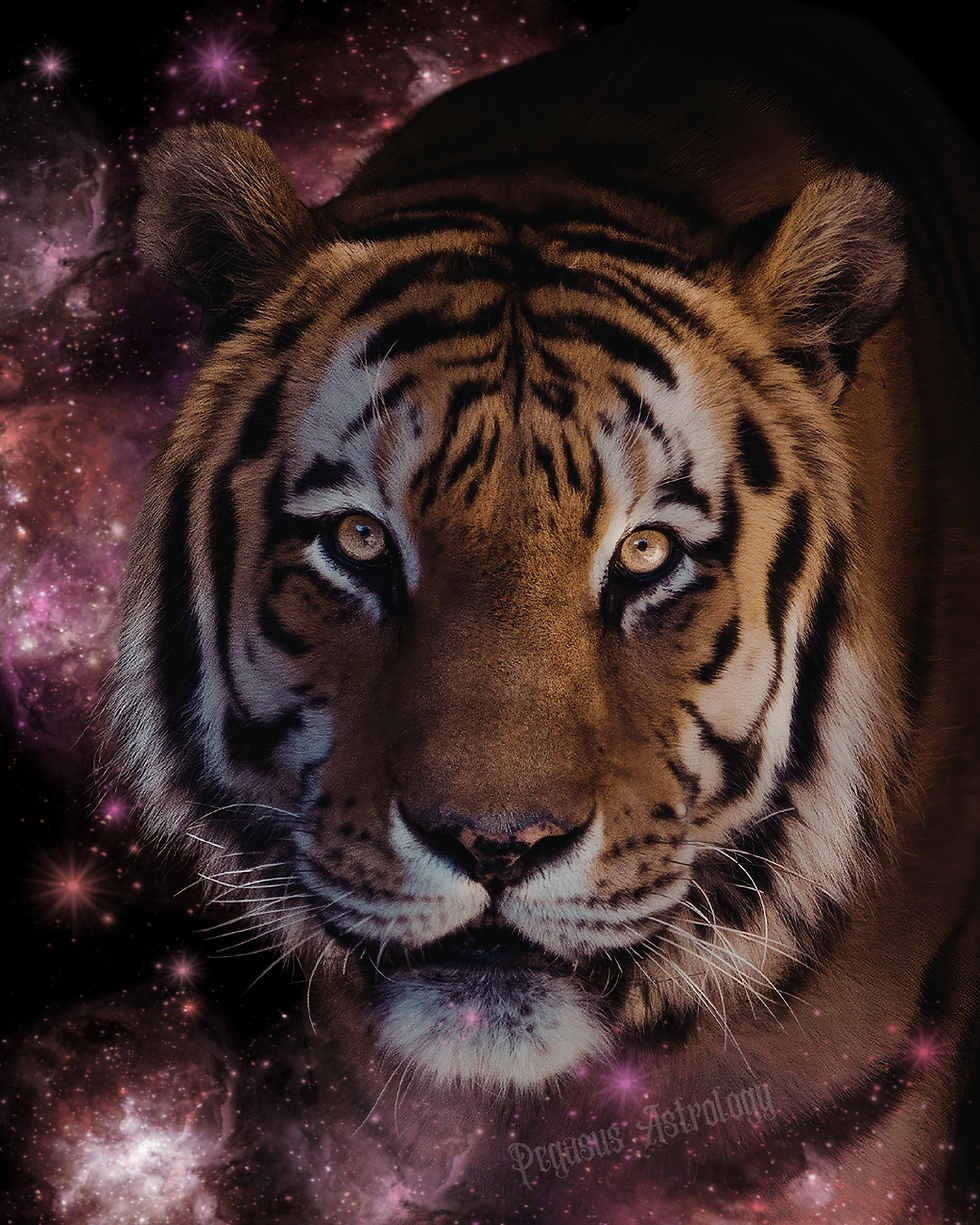
The final animal I would like to introduce to you as a totem of Aries is the tiger.
The tiger is one of my favourite possible contenders for this role, for several reasons. These big cats are solitary and fiercely independent, and like the wolf are agile and skilled predators. They move through their territory with a graceful confidence born from their assurance in their own abilities, and when they have chosen their prey, there is little that can be done to deter them. It is often said that the biggest threat to another tiger (with the exception of the human animal) is no one but another tiger. When Arian types come together, it is not uncommon to witness power struggles and heated arguments, with each wanting to do things their own way and unwilling to compromise. If tigers were pack animals, together they would probably be indomitable, but like people with a lot of Aries energy they prefer to do things on their own - and maybe that’s just as well!
Whilst there is no tiger mythology relevant to Aries or the Aries archetype (that I’m aware of - if you know of any please let me know!), it is worth noting here that in astrology the Sun is exalted in Aries. The Sun represents the ego, the self and the light we shine into the world, and as such it feels very at home in Aries where the qualities of independence and leadership come to the fore. The Sun’s own sign, Leo, is of course the sign of the lion - another big cat! - and so giving the tiger to Aries feels like it holds a really lovely resonance, drawing upon this sacred connection between Aries and Leo.
Final Thoughts
As I’m sure we will see as we progress with this project and work our way through the rest of the zodiac, there are many animals that we might associate with any one sign, each embodying its qualities in their own special way.
If we are needing to find courage in our convictions and jump into something head first, consequences be damned, we might look to the ram to help us. If we have become too anxious about outcomes to make progress and or feel we need to loosen up a little, the carefree lamb could become our guiding light. If it is the fierce protector and brave warrior spirit we must embody, we might turn to the wolf. Struggling to keep momentum (a very Arian problem!)? The hardheaded and persistent woodpecker is our best ally. And we can turn to the tiger when we need to forge our own way and claim our independence.
These are just some examples of how the Arian medicine of these animals can benefit us, and the lessons they can teach us. One animal may resonate with you more than the others, or you might like to call upon each of them at different times, depending on your intentions. There is no right or wrong way of engaging with this process of astrological rewilding, and allowing your intuition to guide you will (in my experience) often produce more rewarding and meaningful results than overthinking it.
You may even like to work with another Arian animal altogether! The animal kingdom is vast and varied, and it would be impossible to write an exhaustive list of creatures that embody the Aries way. I might have also included the bear or the goose, both of whom are associated with the Roman god Mars, or the boar, the vulture or the snake, all of whom are said to be sacred to the Greek Ares.
And it is not only mythology from which we can draw our associations. Certain animals exhibit Arian traits just simply in their way of being - perhaps in their appearance, their temperament, their natural abilities, or a combination of. If you feel inspired by this article and feel so inclined, take out a pen and notebook and see how many Arian animals you can think of. What about them speaks to you of the sign of Aries? How might you work with them when you need to be ‘a bit more Aries’ or you’re facing a particularly Arian challenge? What medicine do they offer? You could even journey in a meditation to meet one of these animals and see what comes up.
If you decide to partake in any of the above, I’d love to know how you get on, what other animals come up for you, and any thoughts all of this brings up. If you haven’t already, please do check out my first post on Rewilding the Zodiac for an introduction to this project and to working with animal symbolism, and if you know someone who you think would love this Rewilding the Zodiac project, please do share it with them!
Until next time, with love and magic,
Merry x


Comments